
Content Schemas
Introduction
Content schemas (formerly named ‘response templates’) define the configuration options available to marketers when creating a personalization decision. They also ensure that all responses returned for a given personalization point follow a consistent structure and data format.
Before starting the hands-on exercises in this workshop, watch the video below to learn more about content schemas in Salesforce Personalization.
Enter the password LearnSPtoday to play the video.
Create a Manual Content Content Schema
In this first exercise, you’ll create a manual content schema that you’ll later use with a personalization point (configured for manual content personalization) in the Personalization Points workshop. This schema will define the structure of the content returned by the decision.
- Search and select
Personalizationfrom App Launcher. - Click on the Content Schemas tab.
- Click New.
- Select the Manual Setup tile and click Next.
- Complete the Content Schema fields with the following values:
- Data Space: default
- Personalization Type: Dynamic Content
- Content Schema Name:
Banner with CTA - RContent Schema API Name:
Banner_with_CTA
- Click Next.
- Add the following attributes. Click Add Attribute to create each additional attribute.
HeaderSub-Header(update the generated API name toSub_Header)CTACTA Destination URLImage URL
- Click Save.
Schema Attributes
Each attribute you add to your content schema configuration creates a corresponding text field that business users can populate when defining a decision or experiment cohort on a personalization point that uses the template.
Recommendations Content Schema
In this next exercise, you’ll create a recommendations content schema that you’ll later use with a personalization point configured for recommendations-based personalization.
- Click New.
- Select the Manual Setup tile and click Next.
- Complete the Content Schema fields with the following values:
- Data Space: default
- Personalization Type: Recommendations
- Content Schema Name:
Recs with Header - Content Schema API Name:
Recs_with_Header
- Click Next.
- Click Add Attribute.
- Enter
Recs Headerin the Attribute Label field. - Click Next.
- Select the following fields from the Available DMO Fields list and click
to add them to the Selected DMO Fields list: - Product Name
- Image URL
- Price
- Product URL
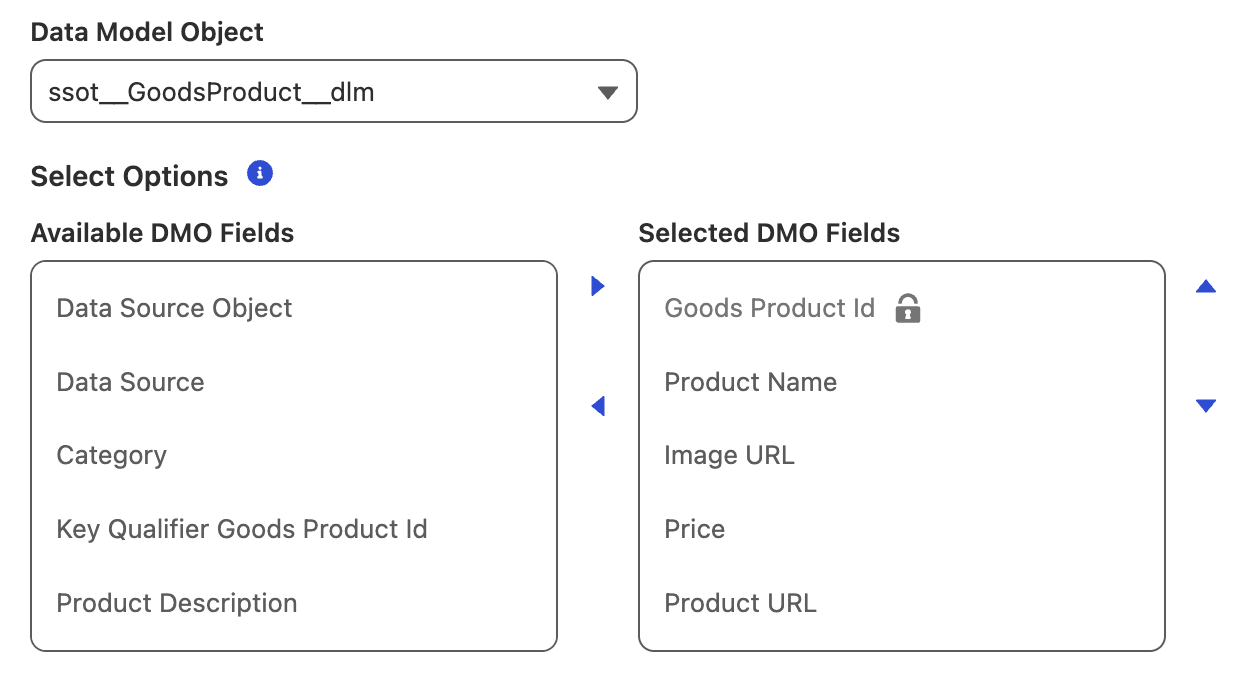
- Click Save.
Data Model Objects and Fields in Recommendation Content Schemas
Note that the Data Model Object field in the recommendations content schema configuration is pre-populated with the Goods Product DMO (ssot__GoodsProduct__dlm). In a recommendations content schema, the objects available for selection are limited to DMOs that act as root objects in an item data graph—that is, objects that are eligible to be returned as recommendation results.
The fields available to include in the schema are the mapped fields on that DMO. However, a recommender can only return fields that are both mapped on the DMO and explicitly selected in the item data graph definition.
Allowing customers to control which item attributes are returned in a decision response is important as it helps prevent sensitive data—such as internal pricing or margin—from being exposed on client-side surfaces like websites or apps. This approach enforces stronger data governance while still giving marketers the flexibility to return the attributes needed for personalization experiences.